Week 8- Photography: Reconceptualising culture, memory and space
Photography has been used to record all aspects of human life and activity (Wright, 1999, p. 1). I believed that mostly everyone have their own photo albums at home. Browsing through my old photographs, I realized that I do not remember almost 50% of the events that is happening inside the photograph.
People always like to take photograph and keep is as a memory, but the question is, can photograph really keep our memory? Then why is that when I look into my old photos that were taken ten years ago, I couldn’t remember anything but only was able to assume what was happening back then? When looking into the photos that were taken recently, I was able to remember the incident but not as clear as what is in the photograph. Sometimes after you look into the photograph then you realized that someone from somewhere was in the event as well which you didn’t expect that person to be there. So does photograph really serves as a memory? Or something that triggers the memory in your mind? Or it is just a technology that extends to your mind? According to Wells (1997), photographs are records and documents which pin down the changing world of appearance.
When we delete a file and empty the recycle bin in a computer, the file is really gone. But think about this, after people broke up with their partners, they deleted or threw away their photos that they took together. Can they really threw away their memory when they were together? Furthermore, we do realize that photograph actually doesn’t make any sense to those who have already lose their memory.
Although by definition, photograph means a picture obtained by using a camera and film that is sensitive to light, it can actually trigger the feelings of human being. That is why we consider photography as a form of cultural critique. Of course, not every photograph are able to act as a cultural critique. Say, you took a photo of a stone, I don’t think it serves as critique to any culture.

This is a photo showing a priest holding the hand of a starving child. This photo serve as a cultural crtique because this photo has moved the United Nations and others to send food to the starving Horn of Africa.
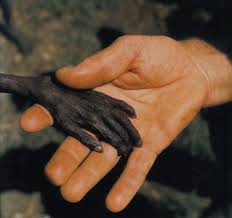
No matter how many times I have seen this photo, it still shivers me.
References:
Wright, T. (1999). Photography Handbook. London and New York: Routledge.
Wells, L. (1997). Thinking about photography. Photography: a critical introduction (pp.24-54) London: Routledge.

No comments:
Post a Comment